PrepShipHub vs. Hopstack: Fulfillment Software Comparison for Prep Centers and 3PLs
PrepShipHub vs. Hopstack.jpg
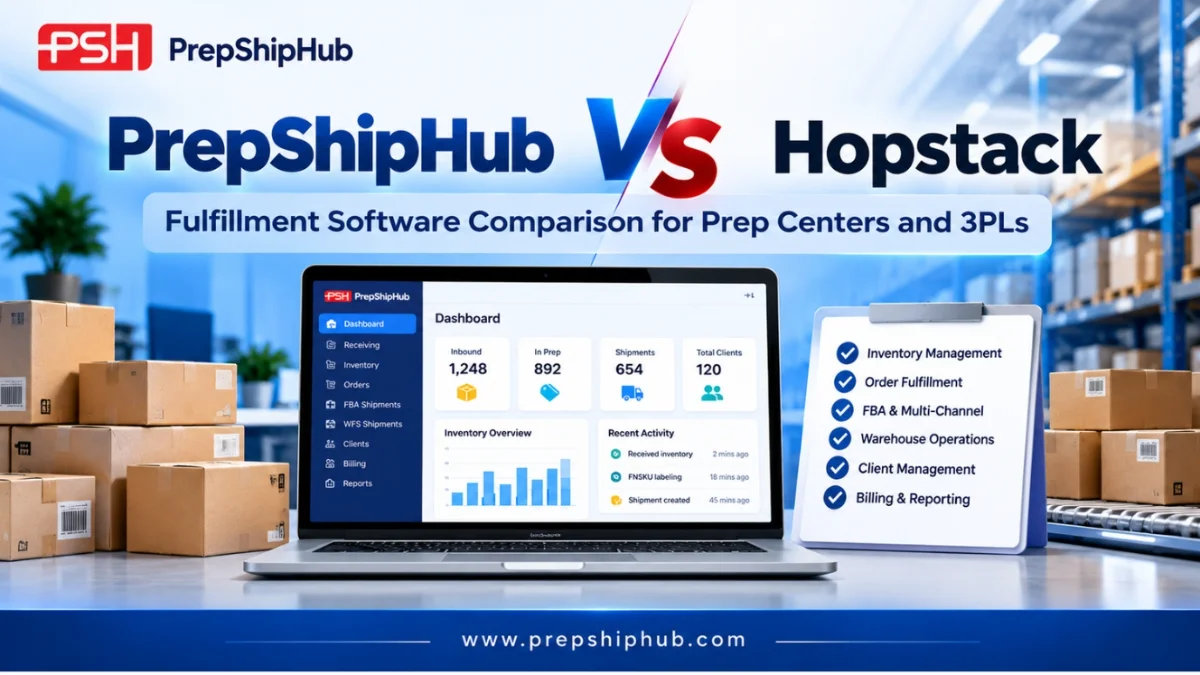
PrepShipHub vs. Hopstack comes up when a prep center or 3PL starts comparing warehouse software that can handle Amazon FBA prep at scale. Both platforms genuinely support FBA prep workflows, so the real decision is not which one covers the basics. It is whether an operation needs industrial-scale warehouse automation, or a platform purpose-built around prep center client management and billing.
This comparison looks at where Hopstack's automation strength actually applies, and where a prep center's day-to-day operations matter more than throughput numbers.
Where Hopstack works well, and where it stretches thin
Hopstack is a capable, well-reviewed platform. Its Amazon FBA prep features include automated shipping plan creation, FNSKU label generation, and prep instructions sourced directly from Seller Central. User reviews on SoftwareAdvice rate ease of use at 4.6 out of 5, with one reviewer reporting proficiency within a day of training.
The limitation shows up in scope and access, not core functionality. Hopstack's FBA prep case studies center on high-throughput, multi-merchant automation, citing results like 350-plus line items prepped per hour, which signals a platform tuned for larger, more complex operations. The FBA prep product itself is demo-only, with no published pricing and no self-service signup. Reviewers also note that custom integrations can take one to two months to implement, and several specifically flagged gaps in 3PL-specific billing features as an area still requiring workarounds.
Where PrepShipHub fits growing prep centers and 3PLs
PrepShipHub was built by operators who ran a prep center themselves, focused specifically on the client-management and billing side of the business rather than industrial warehouse automation. That shows up directly in the platform:
Integrated multi-client billing generated automatically per client, addressing the exact gap reviewers flag in Hopstack
Multi-client inventory management and client-facing portals built around prep center workflows specifically
Onboarding scoped to prep center operations, without a warehouse-automation implementation project attached
Amazon FBA and Walmart WFS workflows designed for the prep center's day-to-day, not a broader logistics network
Consider a 3PL in Ohio running prep operations for 25 Amazon FBA clients without any conveyor systems, robotics, or multi-warehouse automation in place. That operation needs client billing, inventory accuracy, and portal access more than it needs throughput automation built for enterprise-scale fulfillment networks. Paying for automation capacity that never gets used adds cost without adding value.
That same 3PL is more likely to hit friction at invoicing time than at picking speed. Twenty-five clients means twenty-five sets of service charges, storage fees, and shipment costs to reconcile every billing cycle. A platform that automates that reconciliation removes far more manual work day to day than a warehouse automation feature the operation is not yet built to use.
The PrepShipHub platform is scoped to that exact operating model, so a growing prep center is not implementing more system than its current operation actually needs.
What to check before committing to either platform
Hopstack and PrepShipHub both handle FBA prep competently, so the decision comes down to operational fit rather than a missing feature. Confirm these points before signing a contract, including with PrepShipHub's own team:
Does the operation currently use, or plan to use, warehouse automation like conveyors, robotics, or multi-facility routing?
Is pricing published anywhere, or does evaluation require a sales demo before any cost estimate is available?
Does the platform generate per-client invoices automatically, or does billing require manual work outside the system?
How long does a realistic implementation take for an operation of this specific size, not the vendor's largest case study?
What does support look like after go-live, once client billing and shipments are already running through the system?
An operation planning serious warehouse automation investment should weigh Hopstack's automation depth seriously. One focused on client billing, inventory accuracy, and portal access for a growing but not yet automated prep center gets more direct value from a platform built around that scope.
PrepShipHub vs. Hopstack: capabilities at a glance
Capability | PrepShipHub | Hopstack |
Amazon FBA prep workflows | Included | Included |
Warehouse automation and robotics integration | Not the platform's focus | |
Integrated per-client billing | Included | |
Published self-service pricing | Contact for pricing | |
Typical implementation time | Scoped to prep center operations |
Fulfillment software for prep centers vs. fulfillment software for 3PLs
The line between these two buyer types matters more than it first appears. A prep center's software usually needs to prioritize per-client billing, inventory accuracy, and a simple client portal, since the business model is service fees on a defined set of prep tasks. A 3PL running broader warehouse operations across multiple facilities has different priorities, including throughput automation, multi-location routing, and integration depth with enterprise systems like NetSuite.
A platform's strength in one category does not automatically transfer to the other. A prep center evaluating either vendor should ask which buyer type the product was actually designed around, not just which features appear on a comparison page. A 3PL that has already invested in multi-facility routing gets more from Hopstack's automation depth than a single-location prep center would.
The same logic applies in reverse. A 3PL that has outgrown spreadsheets but has not yet invested in physical automation gains more immediate value from tighter billing and portal workflows than from throughput tooling it is not yet positioned to use.
Warehouse automation spending is accelerating industry-wide
"The global warehouse automation market was valued at USD 19.2 billion in 2023 and is projected to grow at a compound annual growth rate of 18.7% through 2030." — Grand View Research, 2023
That growth explains why platforms like Hopstack lead with automation credentials, since enterprise fulfillment operations are investing heavily in that direction. It does not mean every prep center needs to buy into that investment yet.
"The global third-party logistics market was valued at USD 1,261.0 billion in 2025, with growth projected at a 9.1% compound annual growth rate through 2033." — Grand View Research, 2025
Most of that 3PL growth is coming from mid-market operators adding clients and channels, not from warehouses installing robotics, which keeps platform fit a bigger factor than automation depth for most prep centers today.
Frequently asked questions
Q: PrepShipHub vs. Hopstack: which one is better for prep centers and 3PLs?
Hopstack fits an operation investing in warehouse automation and high-throughput, multi-merchant fulfillment. PrepShipHub fits a growing prep center or mid-market 3PL that needs integrated client billing and prep-center-specific workflows without an automation implementation project attached.
Q: Does Hopstack handle Amazon FBA prep center billing?
Hopstack covers core FBA prep tasks like shipping plans and FNSKU labeling, but user reviews specifically note gaps in 3PL-specific billing features that require workarounds. A prep center prioritizing automated per-client invoicing should confirm this directly during a demo.
Q: How much does Hopstack cost compared to PrepShipHub?
Hopstack does not publish pricing for its FBA prep product; evaluation requires a sales demo. PrepShipHub's pricing is tailored to the number of clients and warehouse operations a prep center or 3PL runs, so the most accurate comparison comes from requesting a quote from both vendors.
Hopstack and PrepShipHub both handle Amazon FBA prep competently, but they are built around different operating models. The right choice comes down to whether an operation's next investment priority is warehouse automation or tighter client billing and portal management.
Book a demo to see how PrepShipHub handles multi-client billing and prep center operations without an automation-scale implementation.
Related articles
PrepShipHub vs. PrepBusiness: Head-to-Head for Amazon Prep Centers
The real question is not which tool handles Amazon FBA prep best today. It is whether a prep center plans to stay Amazon-only, or expects to add Walmart, Shopify, or other channels within the next year or two.
 ·Oct 9, 2026·6 min
PrepShipHub vs. Ysell.pro: Which Is the Better FBA Prep Center Software?
Both platforms target the same buyer: an operator managing inventory, billing, and shipments for multiple client accounts rather than a single seller's catalog. That overlap makes the choice harder than picking between a general seller tool and a prep-center-specific one.
·Sep 30, 2026·6 minPrepShipHub vs. Sellercloud: Ecommerce Operations Platforms Compared
Choosing between PrepShipHub vs. Sellercloud comes down to one question: does your business sell products, or does it run fulfillment operations for other sellers?
·Sep 24, 2026·6 min