PrepShipHub vs. PrepBusiness: Head-to-Head for Amazon Prep Centers
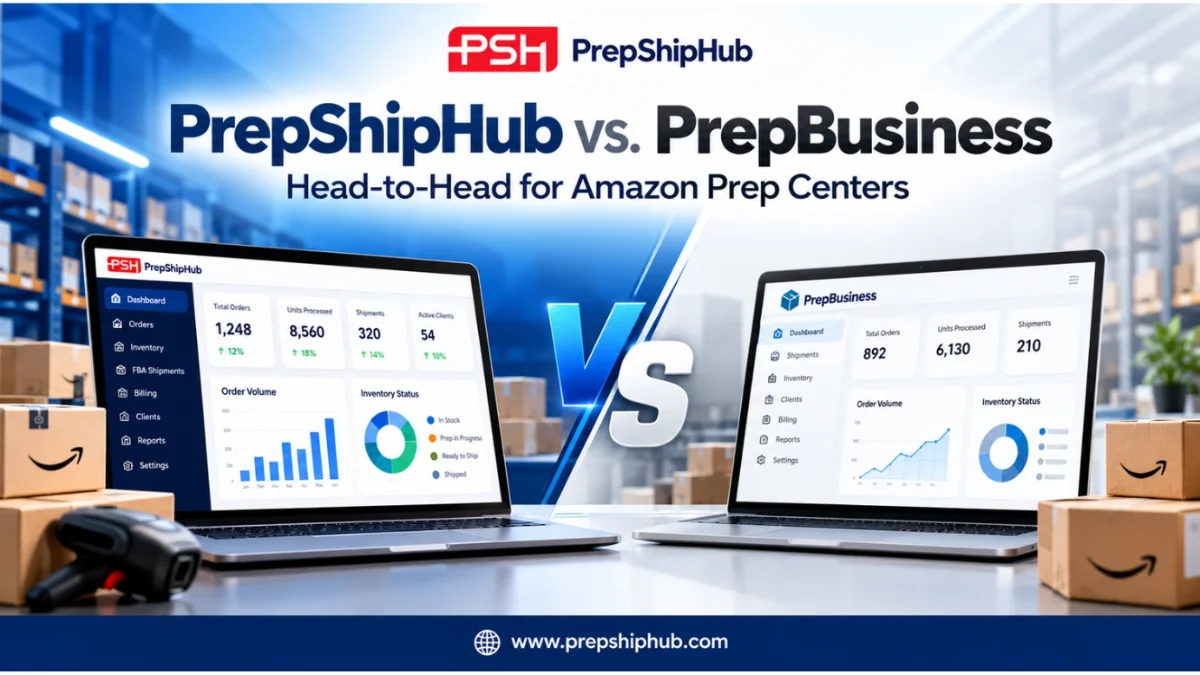
PrepShipHub vs PrepBusiness
PrepShipHub vs. PrepBusiness is the comparison most prep centers reach once they have outgrown spreadsheets and need dedicated software, but the two platforms are built for different stages of growth. The real question is not which tool handles Amazon FBA prep best today. It is whether a prep center plans to stay Amazon-only, or expects to add Walmart, Shopify, or other channels within the next year or two.
This comparison looks at where PrepBusiness genuinely earns its reputation, and where a prep center's growth plans start to matter more than either vendor's feature list.
Where PrepBusiness works well, and where it stretches thin
PrepBusiness is a well-built, Amazon-FBA-specific platform. Its core feature set includes a white-labeled, self-serve client portal, automated billing and invoicing, photo-based inventory reconciliation, and unlimited clients and users on every plan. Pricing is genuinely transparent for the category: plans start at $175 per month for up to 5,000 units, scaling with volume, and PrepBusiness backs it with a 30-day money-back guarantee.
The limitation is scope, not quality. PrepBusiness is built specifically for Amazon Seller Central and FBA shipment workflows, with no published support for Walmart Fulfillment Services, Shopify, or eBay. A prep center that stays Amazon-only will not outgrow that scope. One that starts taking on Walmart WFS or Shopify clients will hit a wall the software was never designed to cross.
Where PrepShipHub fits prep centers planning to grow beyond Amazon
PrepShipHub was built by operators who ran a prep center themselves, then expanded the platform as their own client base moved beyond Amazon. That shows up directly in the feature set:
Native support for Walmart WFS and Shopify order management, alongside Amazon FBA workflows
Multi-client inventory management and client-facing portals that work the same way across every channel
Integrated billing that consolidates charges across channels into one invoice per client
Centralized reporting that shows profitability by client and by channel, not just by shipment
Consider a prep center in Georgia that built its first 30 clients entirely around Amazon FBA, then started fielding requests from clients who also sell on Walmart. Running Amazon prep on one system and Walmart fulfillment on a separate spreadsheet doubles the manual reconciliation work at billing time. A platform built to cover both channels from the same client record removes that duplication before it becomes a monthly habit.
That same prep center also gains a clearer view of which clients and channels actually drive revenue once both feed into one reporting layer. Without that consolidated view, a prep center manager is left comparing exported spreadsheets from two separate systems just to answer a basic profitability question.
The PrepShipHub platform is designed so that adding a new sales channel for an existing client does not mean adding a second system alongside it.
What to check before committing to either platform
PrepBusiness and PrepShipHub both serve Amazon prep centers well today, so the decision comes down to a prep center's own growth plans rather than a feature gap in either tool. Confirm these points before signing a contract, including with PrepShipHub's own team:
Does the prep center have any clients, or sales conversations in progress, involving Walmart, Shopify, or eBay?
If channel expansion happens later, does the current platform support it, or would it require a second system?
How is pricing structured as unit volume grows, and is that scaling published or negotiated case by case?
Does the platform separate billing and reporting by channel, or only by client?
What does the vendor's onboarding process look like, and how long does a full client migration typically take?
A prep center answering "Amazon-only, no plans to change" to the first question has a straightforward decision. One with active or likely multi-channel clients should weigh the cost of switching platforms later against the cost of a broader platform now.
PrepShipHub vs. PrepBusiness: capabilities at a glance
Capability | PrepShipHub | PrepBusiness |
Amazon FBA workflows | Included | Included |
Walmart WFS support | Included | Not offered |
Shopify integration | Included | Not offered |
Client-facing portal | Included | |
Starting price | Contact for pricing | |
Money-back guarantee | Contact for details |
Choosing Amazon prep centers software: what actually changes the decision
For a prep center certain it will stay Amazon-only, PrepBusiness's transparent pricing and Amazon-specific depth make it a strong, low-risk choice. The 30-day guarantee also lowers the cost of testing it directly against day-to-day operations before committing further.
For a prep center already fielding Walmart or Shopify requests, or expecting to within the next year, the calculation changes. Migrating a live multi-client operation to a new platform later costs more in disruption than choosing a platform with that channel coverage from the start.
The switching cost is not just technical. Every client relationship, billing rule, and inventory record has to move at once, and a prep center cannot afford downtime on client billing while that migration happens. Building channel coverage in from day one avoids putting that transition in front of clients who are already depending on accurate invoices and on-time shipments.
Third-party fulfillment keeps growing, which raises the stakes on this choice
"The global e-commerce software market was valued at USD 9.4 billion in 2025 and is projected to grow at a compound annual growth rate of 18.5% through 2033." — Grand View Research, 2025
PrepBusiness itself reports processing more than 35 million items for over 7,000 Amazon companies, according to figures published on its own site, which reflects real depth in the Amazon-only segment specifically.
"The global third-party logistics market was valued at USD 1,261.0 billion in 2025, with growth projected at a 9.1% compound annual growth rate through 2033." — Grand View Research, 2025
As that market grows, more prep centers will face the same fork: stay specialized in one channel, or build the infrastructure to serve clients across several at once.
Frequently asked questions
Q: PrepShipHub vs. PrepBusiness: which one is better for prep centers?
PrepBusiness is a strong, transparently priced choice for a prep center that plans to stay focused on Amazon FBA. PrepShipHub fits a prep center that already serves, or expects to serve, clients on Walmart WFS or Shopify alongside Amazon, since it covers those channels natively.
Q: Does PrepBusiness support Walmart or Shopify sellers?
No. PrepBusiness is built specifically around Amazon Seller Central and FBA shipment workflows, with no published integration for Walmart Fulfillment Services, Shopify, or eBay as of this writing.
Q: How much does PrepBusiness cost compared to PrepShipHub?
PrepBusiness publishes usage-based pricing starting at $175 per month for up to 5,000 units, with a 30-day money-back guarantee. PrepShipHub's pricing is tailored to the number of clients, channels, and warehouse operations a prep center runs, so the most accurate comparison comes from requesting a quote directly.
PrepBusiness and PrepShipHub are both credible choices for Amazon prep centers today. The difference that matters is not which one prepares FBA shipments better right now, but which one still fits once a prep center's clients start selling somewhere other than Amazon. That single question is usually worth more to the decision than any individual feature on either platform's list.
Book a demo to see how PrepShipHub handles prep center operations across Amazon, Walmart, and Shopify from one system.
Related articles
PrepShipHub vs. Ysell.pro: Which Is the Better FBA Prep Center Software?
Both platforms target the same buyer: an operator managing inventory, billing, and shipments for multiple client accounts rather than a single seller's catalog. That overlap makes the choice harder than picking between a general seller tool and a prep-center-specific one.
 ·Sep 30, 2026·6 min
PrepShipHub vs. Sellercloud: Ecommerce Operations Platforms Compared
Choosing between PrepShipHub vs. Sellercloud comes down to one question: does your business sell products, or does it run fulfillment operations for other sellers?
·Sep 24, 2026·6 minPrepShipHub vs. ShipHero: Which 3PL WMS is right for your fulfillment center?
Choosing between PrepShipHub vs. ShipHero usually comes down to one question: how big is your operation today, and how fast is it actually growing?
·Sep 23, 2026·6 min