PrepShipHub vs. Ysell.pro: Which Is the Better FBA Prep Center Software?
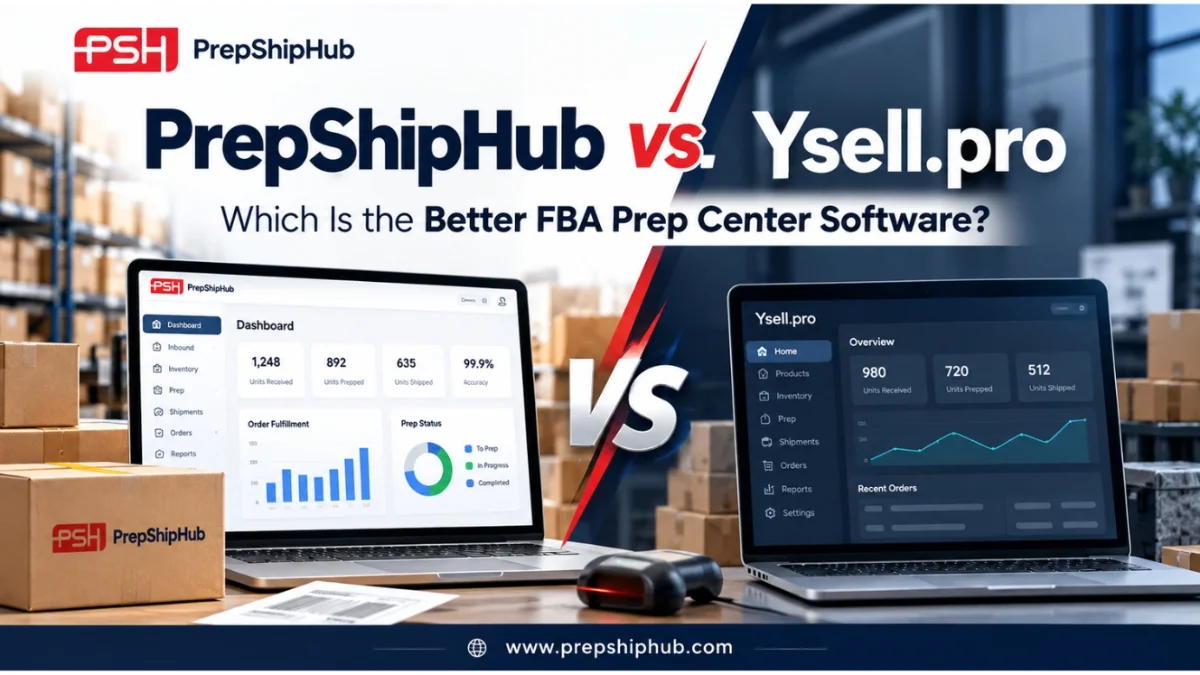
Ysell.pro Alternative.jpg
PrepShipHub vs. Ysell.pro is a comparison that comes up often among prep centers and 3PLs evaluating software built for Amazon FBA operations. Both platforms target the same buyer: an operator managing inventory, billing, and shipments for multiple client accounts rather than a single seller's catalog. That overlap makes the choice harder than picking between a general seller tool and a prep-center-specific one.
This comparison looks at where the two platforms genuinely overlap, and where the differences actually matter for a buyer choosing between them.
Where Ysell.pro overlaps with PrepShipHub, and where it stretches thin
Ysell.pro is a real prep-center contender, not a generic order router. Its FBA prep center features include automatic client billing tied to services requested, client portals for submitting and adjusting shipments, and direct integration with Amazon Seller Central for removals and FNSKU handling. A single published review also describes integration with Shopify, eBay, and Walmart alongside Amazon.
The gaps show up in market presence rather than feature gaps. Ysell.pro's Capterra listing shows only one verified user review, which makes it difficult for a buyer to judge consistency of support or performance at scale. Pricing is also fully custom, with no published tiers and no free trial, so a prep center cannot compare costs without a sales call first. The platform also positions itself broadly as a WMS and ERP system for ecommerce sellers, 3PLs, and fulfillment centers, a wider scope that can dilute its focus on Amazon-specific prep workflows.
Where PrepShipHub fits the prep center and 3PL model
PrepShipHub was built by operators who ran a prep center themselves, not by a software team working from theory. That operational background shows up directly in the platform:
Multi-client inventory management, with stock and shipments tracked separately by client account
Client-facing portals built specifically around Amazon FBA and Walmart WFS workflows
Integrated billing generated per client, without manual invoice building each month
Centralized reporting across inventory, shipments, and profitability, not just prep-floor operations
Consider a 3PL in Texas running prep operations for 20 Amazon FBA sellers, processing inbound shipments across multiple warehouses each week. Choosing a platform with a thin public track record adds real risk at that scale, since a support delay or an unresolved bug affects every client account at once, not just one seller's orders. A platform with an established base of prep center customers reduces that operational exposure before a single box ships.
The PrepShipHub platform was designed around that exact scaling problem. Each new client account plugs into the same billing and reporting structure instead of requiring a separate setup process, which keeps onboarding time consistent as a prep center adds sellers.
What to check before committing to either platform
Ysell.pro and PrepShipHub both target prep centers directly, so the decision comes down to specifics rather than a broad category difference. Confirm these points with either vendor, including PrepShipHub's own team, before signing a contract:
How many prep centers or 3PLs currently run production operations on the platform, not just pilot accounts?
Is pricing published anywhere, or does every quote require a sales conversation?
Does the platform offer a trial period, or is the first real test the live migration itself?
What support response time can the vendor commit to once a client's shipments are already flowing through the system?
Does the platform cover reporting and profitability analysis, or only the prep-floor workflow itself?
A vendor that cannot answer the first two questions clearly is asking a prep center to commit before it can actually compare costs or track record against alternatives.
PrepShipHub vs. Ysell.pro: capabilities at a glance
Capability | PrepShipHub | |
Primary audience | Prep centers, fulfillment centers, and 3PLs | Prep centers, 3PLs, and general ecommerce sellers |
Client-facing portals | Included | Included |
Integrated client billing | Included | Included |
Published pricing | Contact for pricing | |
Free trial | Contact for details | |
Public review volume | Established customer base |
Evaluating prep center software: what buyers should weigh
Feature checklists look similar across most prep center platforms once a vendor covers billing, portals, and Amazon integration. The differences that matter more at contract time are track record, pricing transparency, and how the platform handles reporting once shipments are already moving. A prep center evaluating either option should ask for reference customers of a similar size, not just a features demo.
It also helps to separate prep-floor features from business-level features. Billing and shipment tracking keep daily operations running, but profitability reporting and multi-client analytics are what let an owner see which clients and services actually drive margin. A platform that handles both well reduces the number of separate tools a prep center has to reconcile at month end.
Migration risk is worth weighing too. Moving a live prep center from one platform to another means re-mapping every client account, every SKU, and every billing rule at once. A vendor with a longer production history has usually already solved the edge cases that surface during that kind of switch, which lowers the chance of a disruption that affects multiple clients simultaneously.
The market both platforms are built for is growing fast
"Third-party sellers contributed to 61% of paid units sold on Amazon in Q4 2024." — Statista, 2024
That volume of third-party selling activity is exactly what drives demand for prep centers and 3PLs in the first place, and the logistics side is scaling to match it.
"The global third-party logistics market was valued at USD 1,261.0 billion in 2025, with growth projected at a 9.1% compound annual growth rate through 2033." — Grand View Research, 2025
As more sellers rely on third-party fulfillment, the software gap between vendors with a proven track record and vendors still building one becomes a bigger factor in the decision, not a smaller one.
Frequently asked questions
Q: PrepShipHub vs. Ysell.pro: which one is better for prep centers and 3PLs?
Both platforms cover core prep center needs, including client billing, portals, and Amazon FBA workflows. PrepShipHub is built specifically around the prep center and 3PL model with a broader base of production customers, while Ysell.pro positions itself as a wider WMS and ERP platform with a much smaller public review history to evaluate.
Q: Does Ysell.pro support multi-client billing for prep centers?
Yes, Ysell.pro's FBA prep center features include automatic client billing tied to requested services. The limitation is not the feature itself, but the thin public track record available to confirm how it performs across a large multi-client operation.
Q: How much does Ysell.pro cost compared to PrepShipHub?
Ysell.pro does not publish pricing tiers and does not offer a free trial, so every quote requires a direct sales conversation. PrepShipHub's pricing is tailored to the number of clients and warehouse operations a prep center or 3PL runs, so the most accurate comparison comes from requesting a quote from both vendors.
Ysell.pro and PrepShipHub solve a similar problem on paper, but the details that matter come down to track record, pricing transparency, and how much of the business beyond the prep floor the platform actually covers. A prep center weighing both should ask for real customer references before committing to either one.
Book a demo to see how PrepShipHub handles multi-client prep center operations day to day.
Related articles
PrepShipHub vs. Sellercloud: Ecommerce Operations Platforms Compared
Choosing between PrepShipHub vs. Sellercloud comes down to one question: does your business sell products, or does it run fulfillment operations for other sellers?
 ·Sep 24, 2026·6 min
PrepShipHub vs. ShipHero: Which 3PL WMS is right for your fulfillment center?
Choosing between PrepShipHub vs. ShipHero usually comes down to one question: how big is your operation today, and how fast is it actually growing?
·Sep 23, 2026·6 minBest FBA Prep Center Software: Top PrepBusiness Alternatives for 2027
This guide breaks down where PrepBusiness still performs well, where operators tend to outgrow it, and which alternatives are worth evaluating before you commit to a new platform.
·Sep 17, 2026·6 min