PrepShipHub vs. Sellercloud: Ecommerce Operations Platforms Compared
Sellercloud vs PrepShipHub.jpg
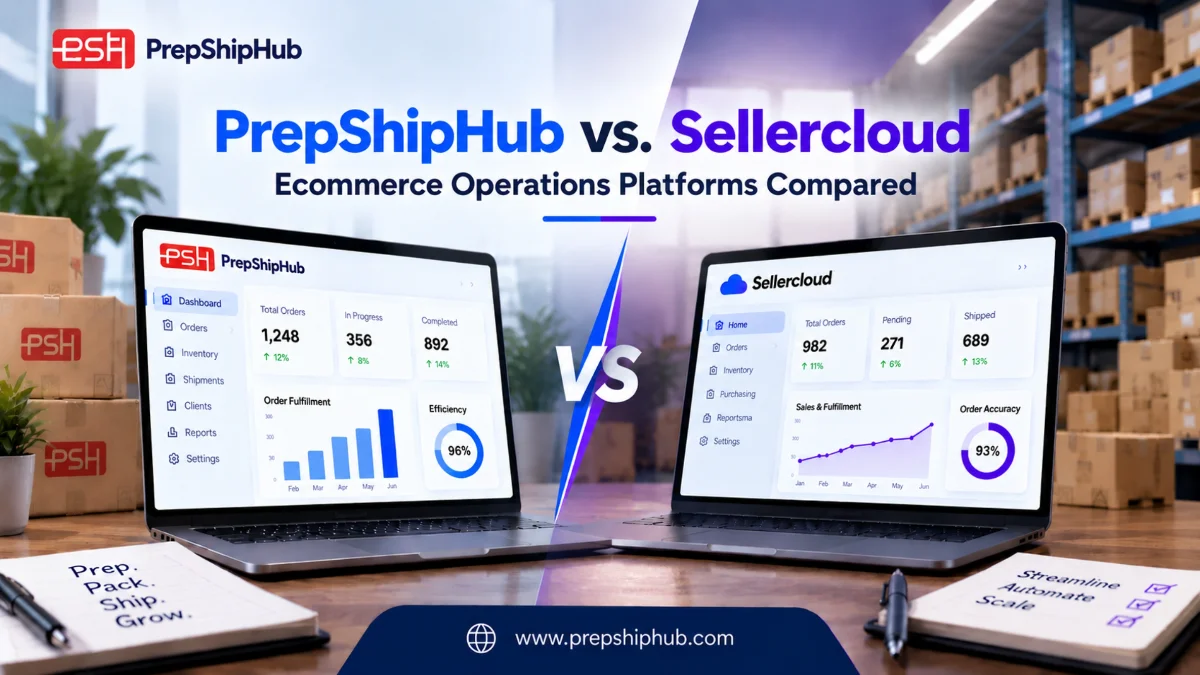
Choosing between PrepShipHub vs. Sellercloud comes down to one question: does your business sell products, or does it run fulfillment operations for other sellers? In 2026, ecommerce management software users have a growing list of platforms promising to simplify inventory, shipping, and order management. Sellercloud built its reputation on multi-channel order routing for individual sellers. PrepShipHub took a different path, adding warehouse operations, multi-client inventory management, and client-facing portals for prep centers and third-party logistics providers.
This comparison breaks down where each platform earns its keep, and where the fit breaks down for operators managing more than one client account.
Where Sellercloud works well, and where it falls short
Sellercloud is built for sellers managing high order volumes across many sales channels. Its core strength is data synchronization across more than 40 marketplace and channel integrations, which keeps inventory counts aligned across Amazon, Walmart, Shopify, and eBay from a single dashboard. For a mid-sized or enterprise seller that has outgrown spreadsheets, that kind of channel coverage is a real operational win.
Pricing starts at roughly $1,349 per month, scaled by order volume and add-ons, with no free trial offered. User reviews describe consistent value for the feature set. They also point to a steep learning curve and onboarding that can stretch to three months before a team is fully productive. Reviewers do not report native support for multi-client billing, per-client inventory segregation, or prep center workflows. Sellercloud is built around one seller managing one catalog, not one operator managing inventory for a dozen different clients.
Where PrepShipHub fits the prep center and 3PL model
PrepShipHub was built by operators who ran a prep center themselves, not by a software team working from theory. That shows up directly in the feature set:
Multi-client inventory management, with stock tracked separately by client rather than pooled into one catalog
Client-facing portals, so each client can check their own inventory and shipments without calling the prep center
Integrated billing, generated per client instead of built manually each month
Workflows designed around Amazon FBA and Walmart WFS operations specifically
Where Sellercloud treats every account as a single seller's catalog, PrepShipHub treats each client as a separate operational unit inside one system.
Consider a prep center in Ohio serving 15 Amazon FBA sellers, processing more than 3,000 inbound units a week across separate client accounts. Without a platform built for multi-client operations, that prep center reconciles invoices, tracks SKUs by client, and checks inventory counts by hand across spreadsheets. Prep centers that move to a platform with built-in multi-client billing typically cut manual reconciliation work by several hours a week. That frees staff to focus on receiving and shipping instead of paperwork.
That operational fit is also why PrepShipHub serves fulfillment centers and 3PLs alongside individual sellers, while Sellercloud's own positioning stays focused on the seller side of the business. The PrepShipHub platform also standardizes inbound shipment tracking across clients. A prep center can see every incoming Amazon FBA or Walmart WFS shipment in one queue, instead of switching between separate seller logins.
What to check before switching platforms
A platform migration is expensive to reverse, so it pays to confirm a few operational details before signing a contract. Run through these questions with any ecommerce operations platform, including PrepShipHub's own feature set, before making a final decision:
Does the platform separate inventory, invoicing, and reporting by client, or does it assume one seller with one catalog?
Can each client log in and see only their own inventory and shipments, or does that require a workaround?
Is billing generated per client automatically, or does someone need to build invoices manually each month?
What does the onboarding timeline look like, and does the vendor provide hands-on support during migration?
Does pricing scale predictably with order volume, or are there hidden add-on costs once volume grows?
A prep center or 3PL that answers "workaround" or "manually" to more than one of these questions is likely paying for staff time that a purpose-built platform would eliminate. A single-brand seller evaluating the same list will usually find that a general multi-channel platform, such as Sellercloud, covers the requirements without added cost.
PrepShipHub vs. Sellercloud: pricing and capabilities at a glance
Capability | PrepShipHub | Sellercloud |
Primary audience | Prep centers, fulfillment centers, and 3PLs | Multi-channel ecommerce sellers |
Multi-client inventory management | Built in | Not a core feature |
Client-facing portals | Included | Not offered |
Integrated client billing | Included | Not offered |
Starting price | ~$1,349/month, scaled by order volume | |
Reported onboarding time | Standard onboarding support | Up to 3 months, per user reviews |
Choosing the best ecommerce operations management software for your operation
The right answer depends on which side of the transaction your business sits on. A single-brand seller scaling across Amazon, Walmart, and Shopify needs strong order routing and channel sync, which is where general multi-channel platforms perform well. An operator managing fulfillment for other businesses needs client separation, billing, and portals built into the core architecture, not bolted on afterward.
Before committing to either path, list out every client or seller account the platform needs to support, and confirm whether the software separates their inventory, invoicing, and reporting by default. That single check usually settles the decision faster than a feature-by-feature comparison.
The ecommerce operations software market is growing fast
"The global e-commerce software market was valued at USD 9.4 billion in 2025 and is projected to grow at a compound annual growth rate of 18.5% through 2033." — Grand View Research, 2025
That growth is not limited to seller-side software. Fulfillment and logistics operators are expanding just as fast, which raises the stakes for choosing a platform that fits the operational model rather than a generic one.
"The global third-party logistics market was valued at USD 1,261.0 billion in 2025, with growth projected at a 9.1% compound annual growth rate through 2033." — Grand View Research, 2025
For prep centers and 3PLs, that scale means more clients, more inbound shipments, and more pressure on systems that were never built for multi-client operations in the first place.
Frequently asked questions
Q: PrepShipHub vs. Sellercloud: which one is better for prep centers and 3PLs?
For a business running fulfillment operations across multiple client accounts, PrepShipHub fits that model directly, with multi-client inventory management, client portals, and integrated billing built in. Sellercloud is a stronger fit for a single seller managing one catalog across several sales channels.
Q: Is Sellercloud good for Amazon FBA prep centers?
Sellercloud's core strength is multi-channel order routing for individual sellers, not multi-client prep center operations. It does not offer native per-client billing or inventory segregation, so a prep center using it typically still relies on spreadsheets to separate client accounts.
Q: How much does Sellercloud cost compared to PrepShipHub?
Sellercloud starts at roughly $1,349 per month, with pricing scaled by order volume and no free trial available. PrepShipHub's pricing is tailored to the number of clients and warehouse operations a prep center or 3PL runs, so the most accurate comparison comes from requesting a quote directly.
Sellercloud and PrepShipHub solve different problems. One routes orders across sales channels for a single seller. The other manages inventory, billing, and client portals for prep centers and 3PLs running operations for multiple accounts at once. If your business operates as a fulfillment partner rather than a single-brand seller, a platform built around that model saves more time than one retrofitted to fit it.
Book a demo to see how PrepShipHub handles multi-client prep center operations day to day.
Related articles
PrepShipHub vs. ShipHero: Which 3PL WMS is right for your fulfillment center?
Choosing between PrepShipHub vs. ShipHero usually comes down to one question: how big is your operation today, and how fast is it actually growing?
 ·Sep 23, 2026·6 min
Best FBA Prep Center Software: Top PrepBusiness Alternatives for 2027
This guide breaks down where PrepBusiness still performs well, where operators tend to outgrow it, and which alternatives are worth evaluating before you commit to a new platform.
·Sep 17, 2026·6 minOrder Fulfillment Software for Ecommerce: A Buyer Guide for Operations Teams
Business owners often evaluate order fulfillment software for ecommerce on features and price. Operations teams have to answer a harder question: will this system fit the workflow you actually run, and can your team be using it well within a few weeks.
·Sep 7, 2026·6 min