5 Features Every 3PL Inventory Management Software Needs for Multi-Client Warehouses
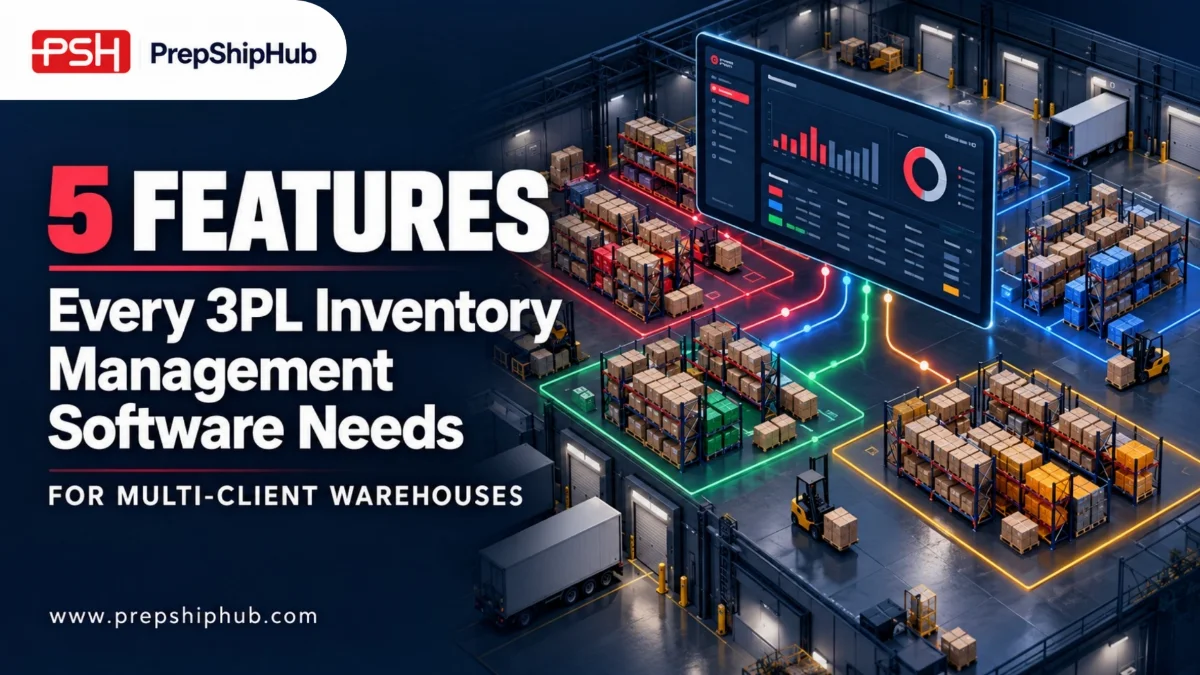
5 Features Every 3PL Inventory Management Software Needs for Multi-Client Warehouses.jpg
A single-client warehouse can get by on basic stock counts and a shared spreadsheet. A 3PL running a multi-client warehouse cannot, because every SKU, bin, and shipment belongs to a specific client's inventory, not a shared pool. That is exactly where generic software breaks down, and why 3PL inventory management software needs a different set of features from the tools built for single-brand sellers.
This article walks through five capabilities that matter most once a warehouse is managing inventory for multiple clients at once, drawn from the evaluation criteria operators actually use rather than a generic feature list.
Why generic inventory software falls short in a multi-client warehouse
Most inventory tools are built around one assumption: one business, one catalog, one set of stock levels. That assumption holds for a single Amazon seller or a direct-to-consumer brand. It breaks the moment a warehouse starts holding inventory for ten, twenty, or fifty separate clients, each with their own SKUs, service agreements, and reporting needs.
A warehouse manager working around that mismatch usually ends up maintaining side spreadsheets to track which pallet belongs to which client, running manual exports to separate billing data, and double-checking pick lists by hand to avoid shipping one client's stock against another client's order. None of that is sustainable past a handful of clients.
What 3PL inventory management software must include for multi-client warehouses
The five features below come directly from how operators evaluate software today, not from a vendor's marketing page. Each one solves a specific operational failure that shows up as client count grows.
1. Location-level inventory tracking
Tracking stock at the SKU level is not enough once a warehouse holds inventory for multiple clients across shared racking. Software needs to track inventory down to the specific bin, shelf, or pallet location, and tie that location to a client record. Without location-level detail, a picker has no reliable way to confirm they pulled the right unit from the right spot, and a cycle count cannot isolate discrepancies to a specific area of the floor.
Bin-level visibility that shows exactly where each client's stock sits, not just how much exists somewhere in the building
Location history tied to every inbound receipt, move, and pick, so a discrepancy can be traced back to a specific event
Support for mixed storage, where multiple clients' SKUs share the same aisle without sharing the same bin record
2. Batch and FIFO or FEFO picking logic
A warehouse handling multiple clients often handles multiple product categories at once, including some with expiration dates or lot-specific requirements. Software needs to enforce first-in-first-out or first-expired-first-out picking automatically, rather than relying on staff to remember which batch came in first. This matters for standard retail goods too, since picking against the oldest available stock reduces aged inventory and the write-offs that come with it.
A prep center in Arizona handling both standard apparel and a client's shelf-stable food products cannot rely on staff memory to apply FEFO logic only where it is needed. Software that enforces batch and expiration rules automatically removes that judgment call from the picking floor entirely.
3. True client segregation, not just tagging
Many platforms claim multi-client support by letting a team add a client field to each SKU. That is tagging, not segregation. Real segregation means a client's data, billing, and inventory reporting stay structurally separate, so one client's report can never surface another client's stock levels, pricing, or shipment activity, even by accident.
Client-specific portals that show only that client's own inventory and order activity
Billing rules and rate cards that apply per client, rather than one global rate applied across the board
Reporting that is scoped by client at the database level, not filtered after the fact in a spreadsheet
Real-time ERP sync and rolling cycle counts round out the list
4. Real-time ERP and marketplace sync
A 3PL's clients each run their own sales channels, whether that is Amazon FBA, Walmart WFS, Shopify, or a direct ERP feed. Inventory management software needs to sync stock levels across those channels in close to real time, not on a nightly batch job. A client who oversells because their warehouse count was twelve hours stale loses a sale and loses trust in the warehouse that is supposed to be managing their stock accurately.
Batch syncing also creates a compounding problem as client count grows. Twelve hours of lag on one client's data is a minor issue; the same lag applied across fifty clients simultaneously multiplies the number of stockouts and overselling incidents a 3PL has to explain every single day.
5. Rolling cycle counts instead of annual physical counts
An annual full-warehouse physical count tells an operator where inventory stood on one day a year. It says nothing about accuracy in the eleven months before or after. Software built for multi-client operations should support rolling cycle counts, where a defined portion of the warehouse gets counted on a continuous schedule, so discrepancies get caught and corrected within days rather than months.
This matters more for warehouse inventory accuracy in a multi-client operation specifically, because a problem that goes undetected for months does not just affect one business. It compounds across every client whose stock shares that part of the floor, and by the time an annual count catches it, the billing and reporting history built on that bad data cannot be easily corrected.
What breaks when a warehouse runs without these five features
Consider a 3PL in Ohio that started with five Amazon FBA clients on a basic inventory spreadsheet and grew to twenty-five clients within two years. By client fifteen, the team was manually reconciling bin locations at the end of every shift.
Billing errors were showing up every month because rate cards lived in a separate file from inventory counts. A single misplaced pallet also took hours to locate, because no system tracked location history. Each of the five features above addresses one specific point in that breakdown, not a hypothetical one.
The PrepShipHub platform was built around that exact operational pattern, with location-level tracking, per-client billing, and client portals built in from the start rather than added on as a workaround.
3PL and warehouse inventory software: the numbers behind the shift
Metric | Figure | What it signals |
|---|---|---|
Global third-party logistics market (2025) | More warehouses are managing inventory for multiple clients than ever before | |
3PL market projected CAGR through 2033 | Multi-client warehouse operations are a growing, not a niche, category | |
Global inventory management software market (2026) | Demand for purpose-built inventory software is scaling alongside 3PL growth | |
Inventory software market projected CAGR through 2033 | Buyers are actively replacing spreadsheets and single-client tools |
Questions to ask before choosing multi-client warehouse software
Feature lists on a vendor's website rarely show how a platform behaves once real client volume hits it. Confirm these points directly, including with PrepShipHub's own team, before committing:
Does the platform track inventory down to a specific bin or location, or only at the SKU and total-quantity level?
Can the system enforce FIFO or FEFO picking automatically, or does that depend on staff following a manual process?
Is client data segregated at the database level, or just filtered by a tag that a report could accidentally expose?
How quickly does a stock change sync to connected marketplaces and ERPs: in real time, or on a scheduled batch job?
Does the platform support rolling cycle counts, or only a full annual physical count?
A vendor that cannot answer the first four questions with specifics is likely asking a warehouse to work around the software's limitations rather than solve them.
Frequently asked questions
Q: What should 3PL inventory management software include for multi-client warehouses?
At minimum, it should include location-level inventory tracking, automated batch or FIFO and FEFO picking logic, true client segregation at the data level, real-time ERP and marketplace sync, and support for rolling cycle counts rather than only an annual physical count.
Q: Why does client segregation matter more than simple inventory tagging?
Tagging a SKU with a client name still leaves every client's data in one shared pool, where a report or export can expose another client's stock levels or pricing by mistake. True segregation keeps billing, reporting, and inventory records structurally separate per client, so that risk does not exist in the first place.
Q: How often should a multi-client warehouse run cycle counts?
Most operators running rolling cycle counts count a defined section of the warehouse on a continuous schedule, often weekly or daily for high-velocity zones, rather than waiting for one annual count. That keeps discrepancies small and traceable instead of discovering months of accumulated errors at once.
A 3PL evaluating inventory software for a multi-client warehouse is not choosing between a long feature list and a short one. The real question is whether the platform was built around the operational reality of separate clients sharing one warehouse, or adapted after the fact from software meant for a single business.
Book a demo to see how PrepShipHub handles location-level tracking, client segregation, and cycle counts for multi-client warehouse operations.
Related articles
PrepShipHub vs. Hopstack: Fulfillment Software Comparison for Prep Centers and 3PLs
Both platforms genuinely support FBA prep workflows, so the real decision is not which one covers the basics. It is whether an operation needs industrial-scale warehouse automation, or a platform purpose-built around prep center client management and billing.
 ·Oct 14, 2026·6 min
PrepShipHub vs. PrepBusiness: Head-to-Head for Amazon Prep Centers
The real question is not which tool handles Amazon FBA prep best today. It is whether a prep center plans to stay Amazon-only, or expects to add Walmart, Shopify, or other channels within the next year or two.
·Oct 9, 2026·6 minPrepShipHub vs. Ysell.pro: Which Is the Better FBA Prep Center Software?
Both platforms target the same buyer: an operator managing inventory, billing, and shipments for multiple client accounts rather than a single seller's catalog. That overlap makes the choice harder than picking between a general seller tool and a prep-center-specific one.
·Sep 30, 2026·6 min