The Hidden Costs of Skipping Fulfillment Software for Ecommerce
The Hidden Costs of Skipping Fulfillment Software for Ecommerce.png
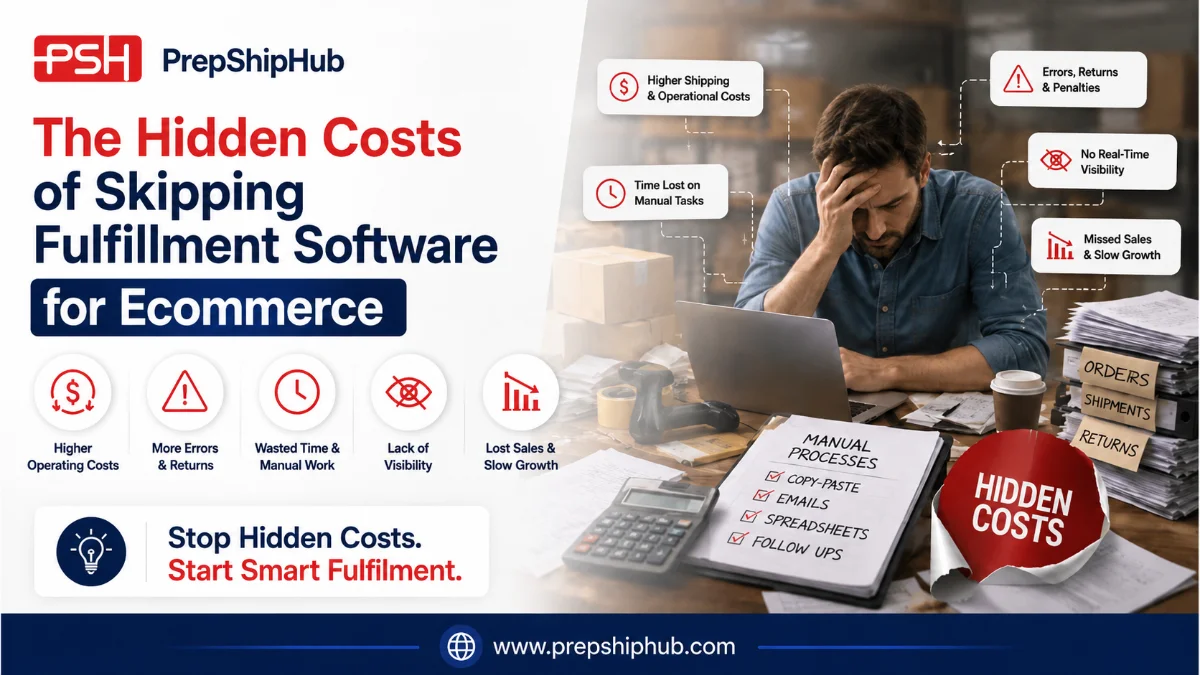
Running ecommerce fulfillment on spreadsheets and manual processes looks free on the surface. There is no monthly subscription, no vendor to onboard, and the workflow is already familiar to your team. But without dedicated fulfillment software for ecommerce, four hidden costs quietly drain margin every month, and they scale with your order volume rather than staying flat.
This piece puts published numbers to each of those costs. You will see what manual fulfillment is actually costing your operation and where fulfillment software for ecommerce would pay for itself.
Why manual fulfillment costs stay invisible
The main reason these costs go unnoticed is that they never show up as a line item. They hide inside labor hours, cancelled orders, return processing, and repeat customers who quietly stop coming back. None of these appear on an invoice, which is why owners often underestimate the real cost of running without dedicated fulfillment software for ecommerce.
Cost 1: Labor hours lost to manual tracking
Every hour spent re-keying orders from marketplaces into a spreadsheet, updating stock counts by hand, or chasing shipment statuses across carrier websites is an hour paid for. That time is never recovered. On a busy shipping day, this can add up to half a full-time role, and further once you factor in the correction work when data gets out of sync.
Manual tracking also scales linearly with order volume. Ship twice as many orders next quarter, and you either need twice the admin hours or you accept that things will start slipping through.
Cost 2: Oversell penalties
When inventory counts live in a spreadsheet that gets updated at the end of the day, marketplace listings sell stock that no longer exists. The result is cancelled orders, refund processing, and marketplace penalties that can restrict your ability to sell.
Amazon, Walmart, and other platforms track cancellation rates as a seller-health metric. A run of oversells from out-of-sync inventory does more than cost you the individual orders. It can affect your account standing and search placement, which quietly reduces revenue for weeks after the incident.
Cost 3: Picking error returns
Manual picking is where a large share of avoidable costs sit. Every wrong item shipped triggers a return, a reship, a refund, or all three.
According to Descartes, the typical warehouse picking error rate runs between 1% and 3%, while the top operations hold it below 0.5%. Each resulting return can cost $15 to $65 to process. On a store shipping 300 orders a day, a 2% error rate is roughly 6 wrong shipments daily, or about $7,200 a month in return handling costs alone. Source: Descartes
That figure covers only the direct handling cost. It does not include the value of the returned inventory, the reship postage, or the customer time your team spends resolving each case. This is one of the clearest places where fulfillment software for ecommerce shows an immediate return.
Cost 4: Customer churn from late shipments
Of the four hidden costs, this one is the largest and the hardest to see. Lost customers rarely tell you they are leaving.
According to the Bringg 2026 Delivery Experience Survey, late delivery is the number one cause of customer churn across all consumer segments. 68% of power shoppers, who represent about 15% of the customer base but 38% of total orders, have stopped buying from a brand after a delivery failure. Because these shoppers rarely complain first, most retailers only notice the loss weeks later in declining repeat purchases. Source: Bringg
When fulfillment runs on manual tracking, late shipments happen more often. Orders get missed, batched incorrectly, or shipped with the wrong service level. Each late delivery is a small event on its own, but the cumulative effect on repeat revenue is the biggest hidden cost on this list.
Adding it up
Looked at one at a time, each of these costs is easy to dismiss. Looked at together, they compound in a way that most manual operations underestimate:
Labor hours that scale with order volume, quietly consuming paid time as you grow.
Oversell penalties that hit both individual orders and your long-term marketplace standing.
Picking error returns that carry direct handling costs of $15 to $65 each, before counting labor and reship expenses.
Customer churn from late shipments, the largest and least visible cost, showing up in declining repeat orders months later.
For a mid-sized operation, the combined monthly figure is usually several thousand dollars, most of which is invisible on standard reports.
How fulfillment software for ecommerce removes these costs
Dedicated fulfillment software attacks each of the four costs directly:
Labor: orders sync automatically from every marketplace, and inventory updates in real time, so staff stop re-keying data by hand.
Oversell risk: live inventory across channels means marketplace listings never show stock you do not have.
Picking errors: barcode validation catches the wrong item before it ships, pushing error rates toward the sub-0.5% range.
Late shipments: guided pick paths, automated label generation, and shipment tracking reduce the delays that trigger customer churn in the first place.
Fulfillment software for ecommerce turns unpredictable, hidden costs into a predictable monthly line item that is usually far smaller than the manual costs it replaces.
How PrepShipHub fits
PrepShipHub is fulfillment software for ecommerce built to remove exactly these hidden costs. It syncs inventory in real time across Amazon, Walmart, Shopify, and your warehouse, validates picks with barcode scanning, and gives operations teams visibility into shipment status without chasing carrier sites. For teams still running on spreadsheets, it converts four unpredictable cost lines into one that you can plan around.
Conclusion
The cost of running ecommerce fulfillment without dedicated software is rarely zero. It is spread across labor hours, oversell penalties, picking-error returns, and customer churn. The total is almost always larger than owners realize until they add it up. Fulfillment software for ecommerce works by making these costs visible and then cutting them, which is why the payback period is usually measured in months, not years.
Reviewed by the PrepShipHub operations team, drawing on direct experience running fulfillment for Amazon FBA, Walmart WFS, and multi-channel sellers.
If you want to see how these numbers look for your own operation, explore PrepShipHub.
Frequently asked questions
What are the hidden costs of manual ecommerce fulfillment?
The four biggest are labor hours lost to manual tracking, oversell penalties from out-of-sync inventory, picking error returns at $15 to $65 per return, and customer churn from late shipments. Together, they usually cost more than dedicated fulfillment software for ecommerce would.
How does fulfillment software for ecommerce reduce these costs?
It automates order and inventory sync across marketplaces, validates picks with barcode scanning to cut error rates, and speeds up shipment processing to reduce late deliveries. That directly addresses all four hidden cost categories.
When is manual fulfillment too costly to continue?
When your monthly cost of returns, oversells, admin labor, and lost repeat customers approaches or passes the price of dedicated software. For most operations shipping more than 100 orders a day across multiple channels, that threshold has already been crossed.
Related articles
PrepShipHub vs. PrepBusiness: Head-to-Head for Amazon Prep Centers
The real question is not which tool handles Amazon FBA prep best today. It is whether a prep center plans to stay Amazon-only, or expects to add Walmart, Shopify, or other channels within the next year or two.
 ·Oct 9, 2026·6 min
PrepShipHub vs. Ysell.pro: Which Is the Better FBA Prep Center Software?
Both platforms target the same buyer: an operator managing inventory, billing, and shipments for multiple client accounts rather than a single seller's catalog. That overlap makes the choice harder than picking between a general seller tool and a prep-center-specific one.
·Sep 30, 2026·6 minPrepShipHub vs. Sellercloud: Ecommerce Operations Platforms Compared
Choosing between PrepShipHub vs. Sellercloud comes down to one question: does your business sell products, or does it run fulfillment operations for other sellers?
·Sep 24, 2026·6 min