Ecommerce Order Fulfillment Software vs. Manual Processes: The Real Cost Comparison
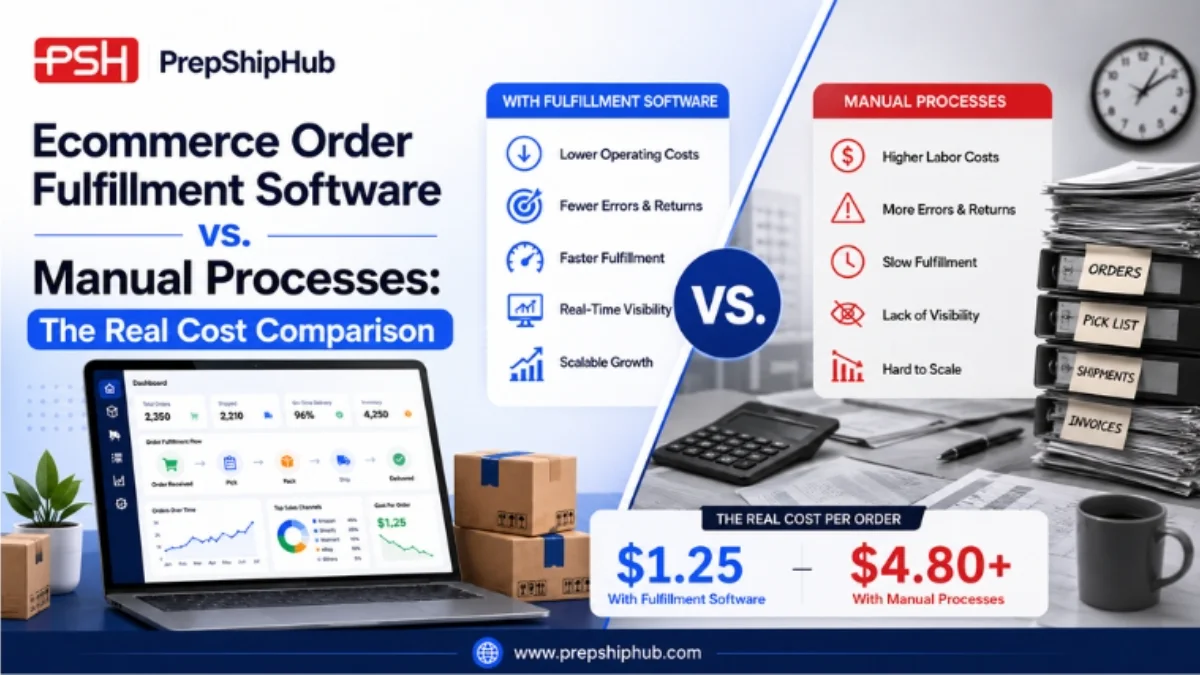
Fulfillment Software vs Manual Processes Cost Comparison.jpg
Manual fulfillment feels cheaper because the costs are hidden. There is no monthly software fee, so a spreadsheet-and-clipboard operation looks like the frugal choice. But the real cost of manual processes shows up somewhere else: in labor hours, picking errors, and stock you oversell because your counts are wrong.
This comparison puts real numbers against both sides. Using published cost-per-order and error-rate data, it shows where ecommerce order fulfillment software actually pays for itself. It also shows how quickly, once you account for the costs manual processes quietly rack up.
The hidden costs of manual fulfillment
A manual operation carries three cost categories that rarely show up as line items, but add up fast as order volume grows:
Labor hours. Manual picking, packing, and order entry are slow. Pickers re-key order data, walk inefficient routes, and update inventory by hand, all of which consume paid hours that scale directly with order volume.
Order errors. Wrong items and quantities lead to returns, reships, and refunds. Each mistake carries a hard cost plus the softer cost of a customer who may not order again.
Overselling losses. When inventory counts are updated manually, they drift out of sync with reality. Selling stock you do not actually have leads to cancellations, marketplace penalties, and lost trust.
According to Descartes, the typical warehouse picking error rate runs between 1% and 3%, while the top operations hold it below 0.5%. Each resulting return can cost $15 to $65 to process. On even a few hundred orders a day, that error range turns into a recurring monthly cost that manual processes have no built-in way to reduce. Source: Descartes
Where ecommerce order fulfillment software cuts costs
Software attacks each of those hidden costs directly, which is what makes the ROI case work. The savings come from three places:
Fewer labor hours per order. Barcode scanning, guided pick paths, and automatic label generation cut the time each order takes. Manual picking often runs 60 to 80 items an hour, while optimized picking software can push past 120 an hour. The same team ends up shipping more orders without working more hours.
Lower error rates. Barcode validation catches the wrong item before it ships, pushing error rates toward the low end of the range and cutting the returns and reships that errors cause.
No overselling. Real-time inventory sync keeps counts accurate across every channel, so you stop selling stock you do not have and avoid the cancellations and penalties that follow.
A simple ROI comparison
Consider a store shipping 300 orders a day. At a 2% manual error rate, that is roughly 6 wrong orders daily, or about 180 a month. If each error costs $40 to resolve between return shipping, processing, and a replacement, that is around $7,200 a month in error costs alone. And that is before counting the labor hours spent picking manually or the revenue lost to overselling.
The labor side adds up just as quickly. Manual picking typically runs 60 to 80 items per hour, while software with guided pick paths and barcode scanning can push that well past 120 per hour. That difference means the same order volume can be handled in close to half the paid hours, or the same team can absorb growth without new hires.
Ecommerce order fulfillment software that cuts the error rate below 0.5% would reduce that same monthly figure to well under $2,000, and the labor savings stack on top. The combined gap, several thousand dollars a month, is usually far larger than the software subscription itself, which is why the payback period is measured in months, not years.
Cost factor | Manual processes | With fulfillment software |
Picking error rate | 1-3% typical | Below 0.5% achievable |
Labor per order | High, scales with volume | Lower, more orders per hour |
Inventory accuracy | Drifts with manual updates | Real-time across channels |
Overselling risk | Frequent at scale | Minimized by live sync |
Cost visibility | Hidden in labor and returns | Predictable subscription |
What to include in your own ROI calculation
Before deciding, run the numbers for your own operation. A realistic comparison includes more than the subscription price on one side and zero on the other. Add up these figures for a full month:
Labor hours spent on picking, packing, order entry, and manual inventory updates, multiplied by your hourly wage cost.
Error costs, using your actual return, reship, and refund expenses, or an estimate based on the 1-3% industry error range.
Overselling losses from cancelled orders, marketplace penalties, and customers who do not return after a stockout.
Put that monthly total next to the cost of ecommerce order fulfillment software plus the time to onboard your team. For most growing operations, the manual column is larger than owners expect once these hidden costs are counted honestly.
When manual processes still make sense
Software is not always the right call yet. If you ship only a handful of orders a day, sell on a single channel, and rarely see a picking error, the hidden costs stay small. In that case, a manual process may genuinely cost less than a subscription. The math shifts once volume grows, error costs become recurring, or you add a second sales channel and inventory starts drifting out of sync.
The practical test is simple: add up what your current errors, returns, and manual labor hours actually cost each month. Once that figure approaches or passes the cost of ecommerce order fulfillment software, manual processes are no longer the cheaper option, they only look like it.
How PrepShipHub fits
PrepShipHub is ecommerce order fulfillment software built to remove exactly these hidden costs. Barcode-validated picking lowers error rates, guided workflows cut labor hours per order, and real-time inventory sync across marketplaces prevents the overselling that manual counts invite. For teams weighing the switch, it turns unpredictable error and labor costs into a predictable monthly line item.
Conclusion
Manual fulfillment is rarely as inexpensive as it looks, because its biggest costs stay hidden in labor hours, order errors, and overselling losses. Ecommerce order fulfillment software makes those costs visible and then cuts them, which is why the payback period is usually measured in months. The right question is not whether software costs more than manual processes, but how much your manual process is already costing you.
Reviewed by the PrepShipHub operations team, drawing on direct experience comparing manual and software-run fulfillment operations.
If you want to see how the numbers work for your own order volume, explore PrepShipHub.
Frequently asked questions
Is ecommerce order fulfillment software worth the cost?
For most growing stores, yes. Manual processes carry labor hours, returns from picking errors, and overselling losses that stay hidden until you add them up. Once you do, ecommerce order fulfillment software usually pays for itself within months rather than years.
How much do manual fulfillment errors actually cost?
Manual picking error rates typically run 1-3%, and each resulting return can cost $15 to $65 to process. At a few hundred orders a day, that becomes thousands of dollars a month in recurring error costs alone.
When should I switch from manual processes to fulfillment software?
Add up your monthly cost of errors, returns, and manual labor. Once that figure approaches the cost of ecommerce order fulfillment software, or you add a second sales channel and inventory starts drifting, switching usually saves money.
Related articles
PrepShipHub vs. ShipHero: Which 3PL WMS is right for your fulfillment center?
Choosing between PrepShipHub vs. ShipHero usually comes down to one question: how big is your operation today, and how fast is it actually growing?
 ·Sep 23, 2026·6 min
Best FBA Prep Center Software: Top PrepBusiness Alternatives for 2027
This guide breaks down where PrepBusiness still performs well, where operators tend to outgrow it, and which alternatives are worth evaluating before you commit to a new platform.
·Sep 17, 2026·6 minHow Fulfillment Software for eCommerce Helps 3PLs Manage Multiple Clients
Running a third-party logistics operation means managing dozens of separate businesses under one roof. Each client has their own inventory, billing terms, reporting expectations, and shipments moving through the warehouse every day.
·Aug 28, 2026·7 min