PrepShipHub vs. ShipHero: Which 3PL WMS is right for your fulfillment center?
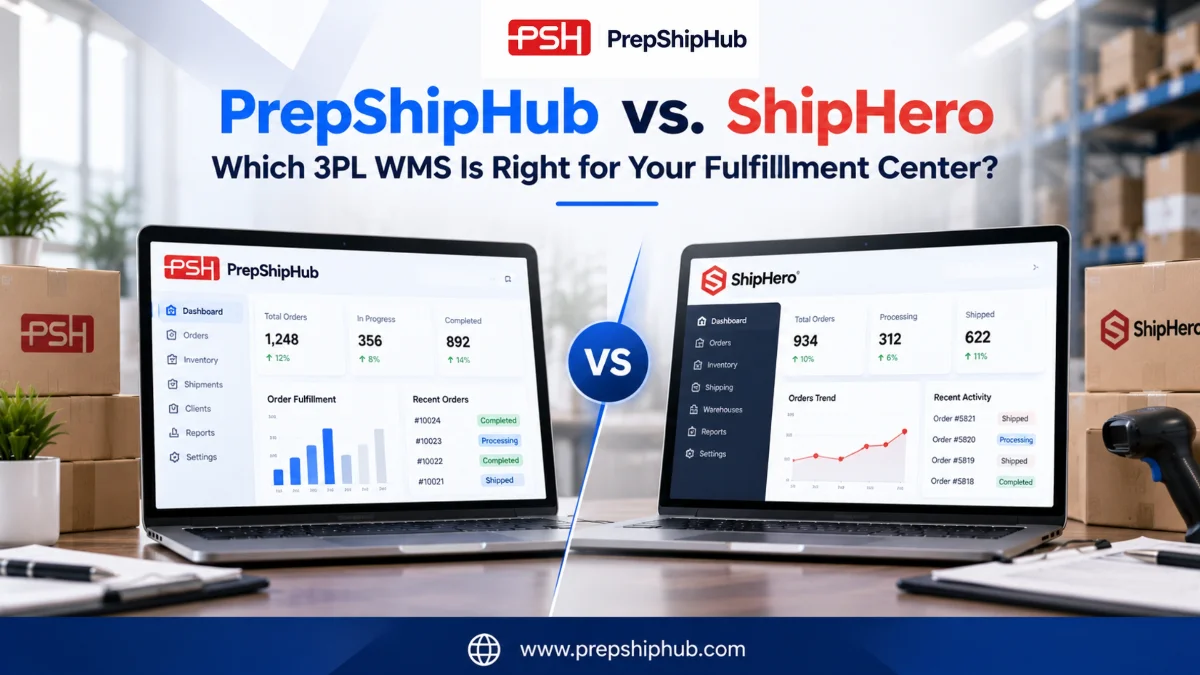
PrepShipHub vs. ShipHero.jpg
Choosing between PrepShipHub vs. ShipHero usually comes down to one question: how big is your operation today, and how fast is it actually growing? ShipHero is a capable warehouse management system built for scaled DTC brands and larger 3PLs, with enterprise pricing and a learning curve to match.
PrepShipHub is built for SMB-to-midmarket prep centers and 3PLs that need to get running fast. There is no six-figure software budget required, and no dedicated ops team needed just to manage the platform. This comparison breaks down where each system fits, so you can match the tool to your actual operation instead of your aspirational one. Getting this decision right up front saves months of migration work later, since moving client data and billing history between platforms is never a quick job.
What to look for in a 3PL WMS
Finding the best 3PL WMS software for fulfillment center operations means looking past the feature list and checking a few specifics:
Onboarding speed — how long before your team is actually processing orders in the new system.
Client billing — whether billable services are tracked automatically or bolted on as an add-on.
FBA prep workflows — native support for FNSKU labeling and Amazon shipment plans, not a workaround.
Pricing transparency — a published cost structure versus a "contact sales" page.
Learning curve — how much training your warehouse staff need before they are productive.
Contract flexibility — whether pricing scales with your client volume or locks you into a fixed enterprise tier regardless of size.
Weighing a platform against this list before signing a contract matters. It is the difference between software that pays for itself in the first quarter and software that sits half-configured while your team keeps working around it. A quick scorecard against these six points, before any demo call, usually surfaces the right answer faster than a sales pitch will.
PrepShipHub vs. ShipHero at a glance
The table below compares both platforms on the factors that matter most to a growing prep center or 3PL.
Factor | PrepShipHub | ShipHero |
Starting price | Built for SMB-to-midmarket budgets | $1,995 per month, plus a $1,000 one-time 3PL onboarding fee |
Client billing | Built in from day one | Available, configured during onboarding |
Amazon FBA prep workflows | Native, ready at setup | Supported through broader warehouse tooling |
Multi-marketplace support | Amazon, Walmart, Shopify, and eBay from one system | Supported, with setup handled during onboarding |
Best suited for | SMB-to-midmarket prep centers and 3PLs | Scaled DTC brands and larger 3PL operations |
Where ShipHero fits best
ShipHero holds up well for operations that have already scaled past the SMB stage. Its labor optimization tools, AI-assisted picking, and rate-shopping features give larger 3PLs and established DTC brands real operational leverage. That leverage matters most across high-volume, multi-warehouse networks, where even small efficiency gains compound across thousands of orders a week.
For a business already running dozens of staff across a distribution center, that depth of tooling can be worth the investment. The ramp-up time it takes to get there is a smaller factor once the team is that size, since larger operations usually have staff dedicated to managing new software.
The tradeoff shows up early, though. Independent reviews describe a genuinely steep learning curve. Onboarding delivers "a lot of information at once," by one reviewer's account. Training new staff on the platform takes real time, and that cost compounds for a team that is still building out its processes.
Users from smaller teams have specifically flagged the cost as more than their operation needs. That lines up with a platform priced and built for scale. A five-person prep center that is still getting its client billing workflow dialed in is not the customer ShipHero's pricing was designed around.
Where PrepShipHub fits best
PrepShipHub is built around a different starting point: an SMB-to-midmarket prep center or 3PL that needs to be operational this week, not next quarter. Client billing, FBA prep workflows, and multi-marketplace support are part of the platform from setup. They are not modules to configure separately after the fact. That matters most for a team without a dedicated implementation specialist on staff.
Consider a prep center running 15 Amazon FBA clients with two warehouse staff. A platform priced for enterprise 3PLs adds a monthly cost that outpaces the client base it is meant to serve. It also comes with a training period the team does not have time for. PrepShipHub's onboarding is built around exactly that kind of operation, so billing, labeling, and shipment workflows are usable within days rather than weeks.
The same logic applies to growth. As that prep center adds Walmart WFS or Shopify clients alongside its Amazon business, the platform needs to keep pace. It should do that without forcing a second, disconnected tool into the workflow. Built-in multi-marketplace support means that expansion does not turn into a systems problem stacked on top of an operations one.
The case for switching
The pressure to adopt purpose-built software is not slowing down. Warehouse management systems are one of the fastest-growing categories in fulfillment technology, and small and midsized operators are a major reason why. Cloud-based platforms, in particular, are pulling ahead of on-premise systems as the default choice for growing operations, largely because they cut the upfront infrastructure cost that used to put dedicated WMS software out of reach for smaller teams.
According to Grand View Research, the global WMS market is projected to reach $4.0 billion in 2026, growing at a 21.9% CAGR through 2033. Adoption is driven in large part by small and midsized enterprises seeking lower-cost, cloud-based alternatives to enterprise platforms.
For a prep center still running spreadsheets alongside a partial software setup, that trend is a signal, not just a statistic. Operators are moving to dedicated platforms earlier in their growth, and the ones sized correctly for their stage are seeing the fastest payoff. Picking software built for a five- or twenty-client operation, rather than a two-hundred-client enterprise, is usually the faster path to that payoff. Paying for enterprise-grade features that a smaller operation will not use for another two or three years of growth rarely earns back its cost in that window.
FAQs
What is the main difference between PrepShipHub vs. ShipHero?
ShipHero is built for scaled DTC brands and larger 3PLs, with enterprise pricing and a steeper onboarding process to match. PrepShipHub is purpose-built for SMB-to-midmarket prep centers and 3PLs instead. Client billing and FBA prep workflows are ready from setup, not configured later.
Is ShipHero worth the cost for a small prep center?
It depends on volume and team size. ShipHero's tooling is strong for high-volume, multi-warehouse operations, and the pricing reflects that positioning. Reviewers from smaller teams have cited the pricing and learning curve as more than a lean operation typically needs, especially before client volume has grown enough to justify it.
How fast can a prep center get running on PrepShipHub?
PrepShipHub is designed for SMB-to-midmarket teams without a dedicated implementation specialist. Billing, labeling, and shipment workflows are typically usable within days of setup rather than weeks, so a new client can be onboarded onto the platform in the same week the contract is signed.
If your prep center or 3PL is ready for software sized to your actual operation, Book a Demo with PrepShipHub and see how the platform fits your team.
Related articles
Best FBA Prep Center Software: Top PrepBusiness Alternatives for 2027
This guide breaks down where PrepBusiness still performs well, where operators tend to outgrow it, and which alternatives are worth evaluating before you commit to a new platform.
 ·Sep 17, 2026·6 min
Order Fulfillment Software for Ecommerce: A Buyer Guide for Operations Teams
Business owners often evaluate order fulfillment software for ecommerce on features and price. Operations teams have to answer a harder question: will this system fit the workflow you actually run, and can your team be using it well within a few weeks.
·Sep 7, 2026·6 minThe Hidden Costs of Skipping Fulfillment Software for Ecommerce
There is no monthly subscription, no vendor to onboard, and the workflow is already familiar to your team. But without dedicated fulfillment software for ecommerce, four hidden costs quietly drain margin every month, and they scale with your order volume rather than staying flat.
·Aug 28, 2026·6 min