PrepShipHub vs. ShipBob: Software Platform vs. Managed Fulfillment Service
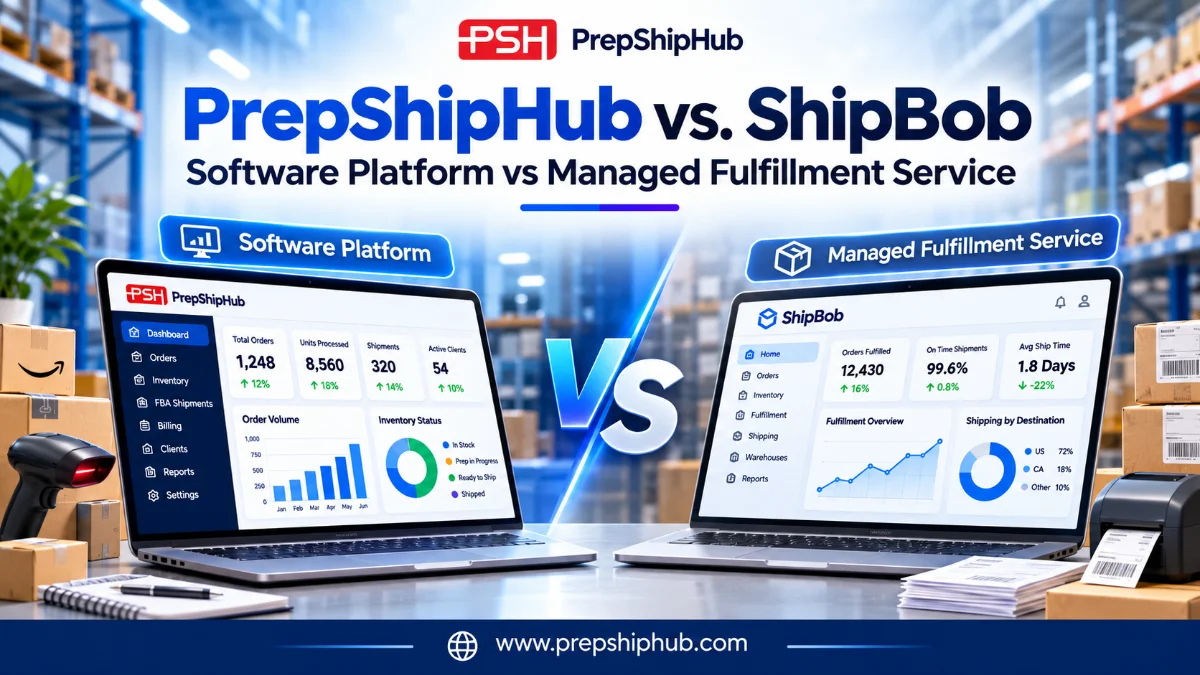
PrepShipHub vs ShipBob
PrepShipHub vs. ShipBob is not really a comparison between two versions of the same thing. Today, it is a decision between two different operating models: running your own fulfillment on purpose-built software, or handing fulfillment to an outside provider that stores your inventory and ships your orders for you.
ShipBob is a managed fulfillment service. PrepShipHub is the software a prep center, 3PL, or brand uses to run fulfillment itself. Choosing between them starts with deciding who should operate your warehouse.
This comparison looks at each model honestly, starting with the operation most prep centers and growing 3PLs actually want to run.
Where PrepShipHub fits: running your own fulfillment
PrepShipHub was built by operators who ran a prep center themselves, as the software layer for a business that fulfills orders on its own terms rather than outsourcing them. That focus shows up directly in the platform:
Multi-client inventory management and client-facing portals built around prep center and 3PL workflows
Integrated per-client billing generated automatically, so a fulfillment business can invoice its own clients
Amazon FBA and Walmart WFS prep workflows designed for the operation's day-to-day
Full control of the warehouse, the client relationships, and the margin on every order fulfilled
The distinction matters most for one group: if you run a prep center or 3PL, ShipBob is not a vendor you would hire. It is a competitor to the service you sell. PrepShipHub is the software you run so you can offer fulfillment yourself, keep your clients on your own platform, and bill them directly, rather than sending that revenue to an outside provider.
Consider a 3PL in Ohio fulfilling orders for 20 Amazon and Walmart clients. Outsourcing those clients to a managed service would mean giving up the client relationships and the per-order margin that are the whole business. What that operation needs is software to run its own warehouse well: accurate multi-client inventory, automatic billing, and portals its clients can log into. The PrepShipHub platform is scoped to exactly that, so a fulfillment operator keeps ownership of the operation instead of renting it.
Where ShipBob fits: outsourced managed fulfillment
ShipBob is a capable, established managed fulfillment service, and for the right business it is a genuinely strong option. A brand ships its inventory to ShipBob's network of warehouses across the US and abroad, and ShipBob receives, stores, picks, packs, and ships every order, with real-time tracking through its dashboard. For a direct-to-consumer brand that does not want to operate a warehouse at all, that is a real advantage.
The trade-offs are inherent to the outsourced model rather than flaws in the product. A brand weighing ShipBob should factor in the following:
Pricing is per order plus storage, receiving, and shipping fees, with a monthly minimum, so costs scale with every order rather than staying fixed like a software subscription
Full quotes require a sales conversation, and some reviewers report that total costs are harder to predict than the base rates suggest
The model trades hands-on control for convenience, so a business that wants to own its fulfillment process has less direct oversight
It is built for brands outsourcing their own orders, not for a prep center or 3PL that wants to fulfill on behalf of its own clients
For a brand that treats fulfillment as a cost to hand off, that structure works well. For an operation that treats fulfillment as the business itself, paying another provider per order is paying away the margin.
PrepShipHub vs. ShipBob: how the two models compare
Factor | PrepShipHub | ShipBob |
|---|---|---|
Model | Software to run your own fulfillment | Outsourced managed fulfillment service |
Who operates the warehouse | You do | ShipBob does |
Best fit | Prep centers, 3PLs, and brands keeping fulfillment in-house | DTC brands that want to outsource fulfillment entirely |
Cost structure | Software subscription | Per-order fees plus storage, receiving, and shipping |
Multi-client billing and portals | Built in, for your own clients | Not the model; ShipBob is the fulfiller |
Control of operations and margin | Retained in-house | Handed to the provider |
What the decision really comes down to
The honest split is not that one option is better than the other. They answer different questions, and the right choice follows from how a business sees fulfillment.
If fulfillment is a chore a brand would rather not handle, outsourcing it to a managed service like ShipBob is a reasonable way to offload the warehouse entirely. If fulfillment is the business, or a capability a brand wants to keep in-house, then ecommerce fulfillment software that lets the operation run its own warehouse protects both control and margin.
The cost logic reinforces the split. Outsourced per-order pricing is efficient at low or unpredictable volume, because a brand pays only for what ships. As volume grows and becomes steady, running fulfillment on owned software and infrastructure often costs less per order, and it keeps the client relationships and the margin inside the business.
Before committing to either model, a decision-maker should confirm a few points, including with PrepShipHub's own team:
Is fulfillment a cost to outsource, or a capability the business wants to own and potentially sell to clients?
At current and projected volume, do per-order fees or a software subscription cost less over a year?
Does the business need to bill and manage its own clients, which an outsourced fulfiller does not support?
How much control over process, packaging, and inventory does the operation need day to day?
Is the goal to hand off the warehouse, or to run it better?
Both models sit in a market that keeps growing
"The global third-party logistics market was valued at USD 1,261.0 billion in 2025, with growth projected at a 9.1% compound annual growth rate through 2033." — Grand View Research, 2025
That growth is why outsourced fulfillment services like ShipBob have scaled: plenty of brands prefer to hand fulfillment off. The same growth, though, is expanding the number of prep centers and 3PLs that run fulfillment as their core business.
"The global warehouse management system market was valued at USD 3.4 billion in 2025 and is projected to grow at a compound annual growth rate of 21.9% through 2033." — Grand View Research, 2025
The faster growth in warehouse management software reflects how many operations are choosing to run fulfillment themselves rather than outsource it. For those operators, the decision is not which fulfiller to hire, but which software to run.
Frequently asked questions
Q: PrepShipHub vs. ShipBob: which one should a prep center or 3PL choose?
A prep center or 3PL should choose PrepShipHub, because ShipBob is an outsourced fulfillment provider that would compete with the fulfillment business itself rather than support it. PrepShipHub is the software that lets a prep center or 3PL run its own operation, bill its own clients, and keep the margin in-house.
Q: Is ShipBob cheaper than running fulfillment on software?
It depends on volume. ShipBob's per-order pricing is efficient at low or unpredictable order volume, since a brand pays only for what ships. At steady, higher volume, running fulfillment on owned software and infrastructure often costs less per order and keeps the margin inside the business.
Q: Can ShipBob replace a warehouse management system?
For a brand that outsources fulfillment to ShipBob entirely, it removes the need to run a warehouse at all. For a business that wants to operate its own warehouse, it needs warehouse management software rather than an outsourced service, since the two solve different problems.
PrepShipHub and ShipBob are both credible, but they are not substitutes. One is the software for running your own fulfillment; the other is a service that runs fulfillment for you. The right choice comes down to whether a business wants to own its fulfillment operation or hand it off.
Book a demo to see how PrepShipHub lets prep centers, 3PLs, and brands run multi-client fulfillment on their own terms.
Related articles
Best 3PL Software for Small Businesses in 2027: Top 10 Picks
The picks below rank the best 3PL software with the small-operator buyer in mind. That buyer needs multi-client billing, accurate inventory, and room to grow, without an enterprise budget or a months-long implementation.
 ·Nov 20, 2026·9 min
PrepShipHub vs. Logiwa: Which Fits Your 3PL?
PrepShipHub vs. Logiwa is the comparison that comes up when a growing fulfillment center weighs a prep-center-focused platform against a high-volume cloud warehouse management system. Today, both run multi-client fulfillment, so the real decision is not which one has more automation.
·Nov 10, 2026·6 minHow to Prepare Your 3PL and Prep Center for Q4 Ecommerce Peak Season
Q4 is where a fulfillment operation either proves itself or loses clients. Good 3PL prep center Q4 peak season preparation is not a last-minute scramble in November. It is a set of decisions made in advance, across inventory, communication, software, carriers, and staffing.
·Nov 3, 2026·6 min