How to Choose the Right Ecommerce Order Fulfillment Software for Your Business
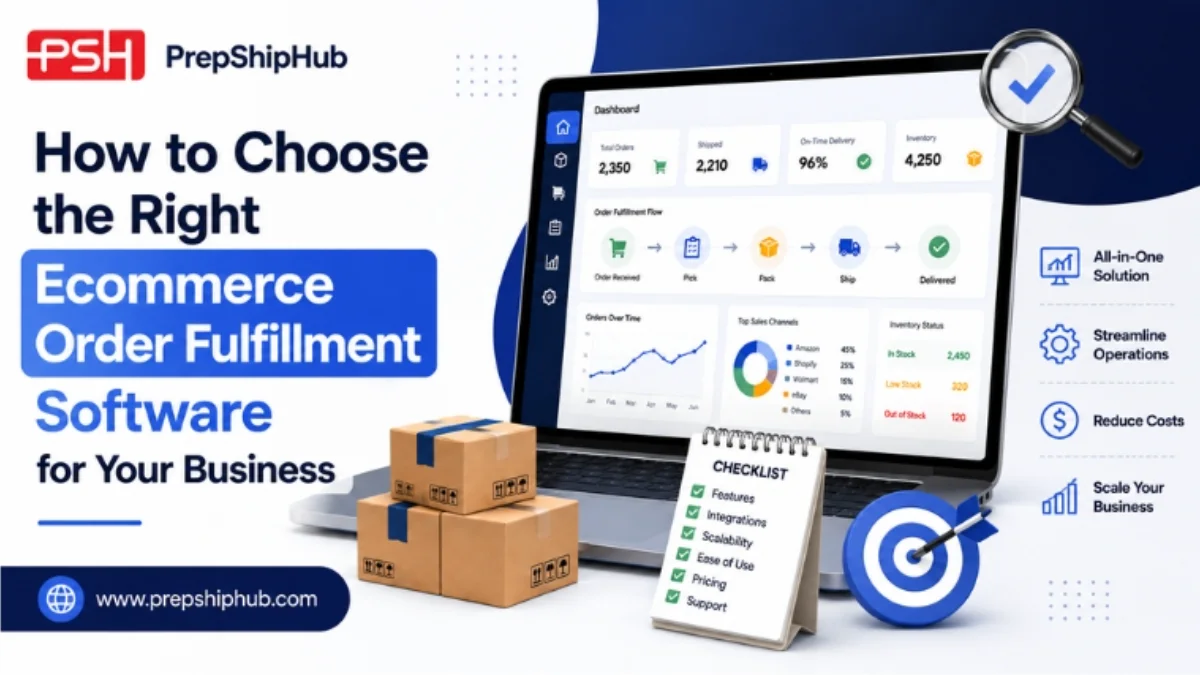
How to Choose the Right Ecommerce Order Fulfillment Software for Your Business.jpg
Most growing brands make the same mistake when they outgrow manual fulfillment: they bend their operation around a generic warehouse system instead of choosing ecommerce order fulfillment software built for how online orders actually ship. The result is a tool that technically works but fights your team at every step, from marketplace syncing to peak-season volume.
Choosing the right ecommerce order fulfillment software is an operational decision, not just a software purchase. This guide walks through the criteria that matter most: marketplace integrations, scalability, prep and operational workflows, and how purpose-built software compares to a generic warehouse management system.
What to look for in ecommerce order fulfillment software
The difference between order fulfillment software that helps and software that hinders usually comes down to fit. A system built for ecommerce understands marketplaces, per-order shipping rules, and the way inventory moves across channels, while generic warehouse management software treats every order like a warehouse line item.
The criteria below are the ones operations teams tend to wish they had weighted more heavily after a rollout goes sideways. Work through each one against your own order volume and sales channels before you commit.
Marketplace and channel integrations
Integrations are the single biggest predictor of whether ecommerce order fulfillment software will save time or create it. Everything downstream, from inventory accuracy to how fast orders ship, depends on how cleanly the software connects to the channels you sell on. Two things matter most here:
Native connections, not manual workarounds. The software should connect directly to every marketplace and storefront you sell on, including Amazon, Walmart, and Shopify. A tool that needs manual CSV uploads for even one channel creates a weekly task your team will grow to dread, and a place where errors quietly accumulate.
Real-time multi-channel inventory sync. When you sell the same product across several channels, inventory has to sync in real time or you risk overselling stock you do not have. An ecommerce fulfillment platform keeps counts accurate across every channel and your warehouse from one dashboard, rather than leaving your team to reconcile numbers by hand.
Scalability criteria
The software that fits at 100 orders a day should still fit at 1,000. Before you commit, pressure-test how the system handles growth on two fronts:
Order volume growth. Ask vendors how their system performs as volume climbs, and whether pricing or performance changes sharply at higher tiers. A well-designed ecommerce fulfillment platform should scale with you rather than forcing a switch once you cross a threshold.
Seasonal spikes without re-platforming. Seasonal peaks are where under-built systems break. The right ecommerce order fulfillment software absorbs a holiday spike without forcing you to switch tools or rebuild workflows, so you are not re-platforming during your busiest month of the year.
According to the U.S. Census Bureau, ecommerce accounted for 16.4% of total U.S. retail sales in the first quarter of 2026, up from 15.9% a year earlier. As online orders take a steadily larger share of retail, fulfillment software that can keep pace with rising volume becomes a bigger operational advantage. Source: U.S. Census Bureau
Prep center and operational workflows
This is where the gap between purpose-built and generic tools shows up most clearly. Warehouse systems assume a simple store-and-ship model, but ecommerce operations often layer prep, kitting, and client work on top of that, and the software has to keep up. Look closely at two areas:
Support for prep, kitting, and labeling. If your operation handles FBA prep, kitting, bundling, or specialized labeling, the software needs to support those workflows directly rather than forcing manual steps around a system that was not designed for them.
Client and multi-account handling. Brands that also fulfill for others, or run as a prep center, need fulfillment software for prep centers that can separate inventory, billing, and reporting by client. A generic system rarely handles multi-account operations well, which becomes a problem the moment you take on a second client. Fulfillment software for prep centers built around this need keeps each client's data cleanly separated from the start.
Purpose-built fulfillment software vs. generic WMS tools
A generic warehouse management system is built to track inventory in a warehouse, not to run ecommerce fulfillment. It often lacks native marketplace connections, treats multi-channel selling as an afterthought, and rarely supports prep or client workflows out of the box.
Software designed specifically for ecommerce starts from the ecommerce use case. It assumes you sell across marketplaces, ship per-order, and may handle prep or multiple clients, so the features you need are built in rather than bolted on. For most ecommerce sellers, that difference shows up as fewer manual workarounds and a faster path to a working operation.
A brand shipping across Amazon, Walmart, and Shopify spent weeks trying to force a generic WMS to sync inventory across all three, before switching to purpose-built software that connected to each channel natively in a fraction of the time. Use this checklist to compare an ecommerce fulfillment platform against a generic warehouse management system before you decide:
Criteria | Purpose-built fulfillment software | Generic WMS |
Marketplace integrations | Native connections to Amazon, Walmart, Shopify | Often manual or via connectors |
Multi-channel inventory sync | Real-time across channels | Frequently batch or manual |
Prep and kitting workflows | Supported directly | Rarely built in |
Multi-client handling | Separates inventory and billing by client | Usually single-account |
Setup time | Faster, ecommerce-ready | Longer, requires configuration |
How PrepShipHub fits
PrepShipHub is purpose-built fulfillment software for ecommerce sellers and prep centers. It connects natively to major marketplaces, syncs inventory in real time, and supports prep, labeling, and multi-client workflows that generic warehouse management software tends to leave out. For operations teams weighing their order fulfillment software options, it removes most of the workarounds that make a generic system frustrating to run.
Conclusion
Choosing ecommerce order fulfillment software comes down to fit: marketplace integrations that match your channels, scalability that survives your busiest season, and support for the prep and client workflows your operation actually runs. Purpose-built software tends to win on all three against a generic warehouse system, because it starts from how ecommerce ships rather than how a warehouse stores.
Reviewed by the PrepShipHub operations team, drawing on direct experience running ecommerce fulfillment and prep center operations.
If you want to see how purpose-built software compares for your operation, explore PrepShipHub.
Frequently asked questions
What is ecommerce order fulfillment software?
It is a system that manages how online orders are received, picked, packed, and shipped across sales channels. Unlike a generic warehouse system, ecommerce order fulfillment software connects directly to marketplaces and syncs inventory across every channel you sell on.
Is a generic WMS good enough for ecommerce fulfillment?
It can work, but a generic warehouse management system usually lacks native marketplace integrations, real-time multi-channel sync, and prep or client workflows. Most ecommerce sellers end up building manual workarounds that purpose-built software avoids.
What features matter most when choosing ecommerce order fulfillment software?
Prioritize native marketplace integrations, real-time multi-channel inventory sync, scalability through seasonal spikes, and support for prep or multi-client workflows if your operation needs them. These are the areas where a poor fit creates the most manual work.
Related articles
PrepShipHub vs. Ysell.pro: Which Is the Better FBA Prep Center Software?
Both platforms target the same buyer: an operator managing inventory, billing, and shipments for multiple client accounts rather than a single seller's catalog. That overlap makes the choice harder than picking between a general seller tool and a prep-center-specific one.
 ·Sep 30, 2026·6 min
PrepShipHub vs. Sellercloud: Ecommerce Operations Platforms Compared
Choosing between PrepShipHub vs. Sellercloud comes down to one question: does your business sell products, or does it run fulfillment operations for other sellers?
·Sep 24, 2026·6 minPrepShipHub vs. ShipHero: Which 3PL WMS is right for your fulfillment center?
Choosing between PrepShipHub vs. ShipHero usually comes down to one question: how big is your operation today, and how fast is it actually growing?
·Sep 23, 2026·6 min